




What Is a Case Study in Psychology?
A case study psychology definition involves an in-depth examination of a specific subject, often employing multiple research methods such as interviews, observations, and psychological assessments. The primary purpose is to gain a comprehensive understanding of the subject's thoughts, feelings, behaviors, and experiences within a particular context.
In this nuanced examination, psychology researchers often employ multiple avenues to collect comprehensive data. Interviews allow for direct insights into the individual's perspective, observations enable the recording of behavioral patterns, and psychological assessments provide objective measurements of cognitive and emotional aspects.
These psychology case studies become particularly invaluable when researchers aim to explore rare or unusual phenomena, intricate psychological mechanisms, or the impact of specific interventions. The focused approach on a single case or a small group allows psychologists to unearth nuanced details that might be overshadowed in more extensive, generalized studies.
Moreover, the depth of information gathered in case studies serves not only to understand the individual case at hand but also to contribute to the broader body of psychological knowledge. The unique insights gained from these detailed examinations can inform the development and refinement of psychological theories, therapeutic approaches, and interventions.
Meanwhile, if you're seeking professional assistance with requests like 'write papers for me,' this guide can be immensely helpful for you.
The Significance of Psychology Case Studies
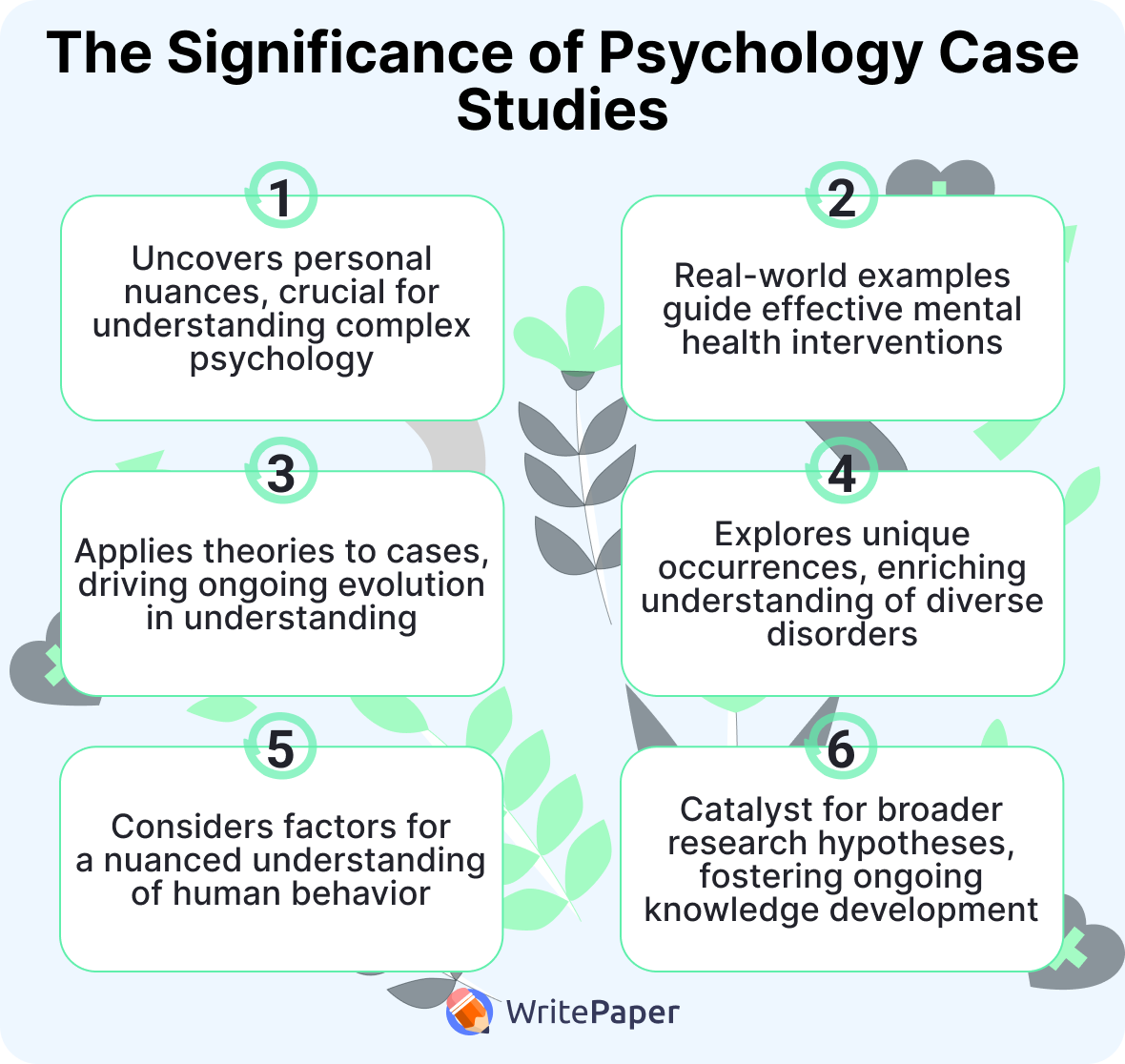
While psychology embraces various research methodologies, the significance of case studies cannot be overstated. These detailed investigations offer unique contributions to the field, providing a depth of insight that other examination methods may struggle to achieve. Here are some of the reasons why these research methods are important according to our case study writing services:
- Individual experience insight: Case study psychology delves into the intricacies of single thoughts and emotions, providing a crucial depth of understanding, particularly when studying rare or complex psychological phenomena. This method allows researchers to capture the unique nuances of personal experiences, contributing to a richer understanding of human behavior.
- Clinical practice guidance: Case studies serve as real-world examples that inform clinical psychologists about mental health disorders and effective interventions. By showcasing practical scenarios, they become valuable tools for refining therapeutic techniques and tailoring treatments to personal needs.
- Theory validation and refinement: These investigations in psychology play a pivotal role in the validation and refinement of psychological theories. By applying theories to real-world cases, researchers can assess their applicability, effectiveness, and potential modifications. This iterative process contributes to the ongoing evolution of psychological understanding.
- Identification of rare phenomena: Case studies are particularly adept at exploring unique occurrences that are challenging to replicate in controlled settings. By focusing on these less common disorders or behaviors, researchers gain insights that might be overlooked in broader studies, enriching our understanding of the diverse spectrum of psychological phenomena.
- Holistic understanding of behavior: The holistic nature of case studies takes into account cultural, social, and environmental factors. This comprehensive approach provides a nuanced understanding of how these elements interact and impact human behavior, offering a more complete view than traditional, more narrowly focused examination methods.
- Hypotheses generation: Case studies often serve as the catalyst for generating hypotheses for broader research. Insights gained from these detailed investigations become the foundation for subsequent studies, experiments, or clinical trials. This continuous cycle fosters the ongoing development and expansion of psychological knowledge.
Types of a Psychology Case Study
When thinking about how to write a psychology case study, it's essential to recognize the diversity in this field and the various types of case studies conducted. Let's take a closer look at these different types:
1. Personal case studies:
- Definition: Singularly focused on a specific individual, these psychology case studies provide an exhaustive examination of their cognitive profile, life experiences, and behaviors.
- Examples: Noteworthy instances include the case of Phineas Gage, whose personality underwent profound changes after a traumatic brain injury, and the examination of patient H.M., renowned for severe amnesia.
2. Group case studies:
- Definition: Shifting the lens to a collective perspective, group psychology case studies involve the analysis of a specific group, community, or organization. The aim is to comprehend the shared mental dynamics within the chosen context.
- Examples: These studies might involve examining the effects of a shared trauma on a group or exploring the intricate dynamics within a particular social group.
3. Longitudinal case studies:
- Definition: Engaging in prolonged observation and analysis, longitudinal case studies track a subject or group over an extended period. This approach proves invaluable for understanding developmental changes,